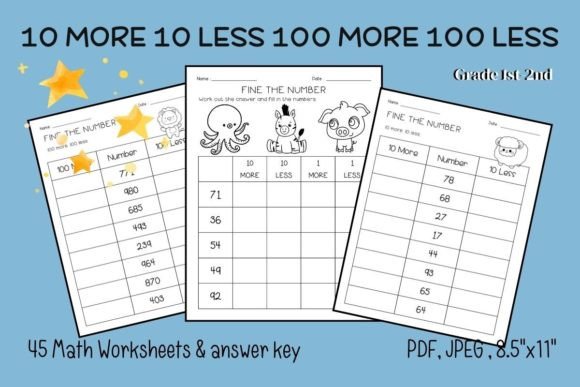
Mastering Number Sense: The Power of 10 More, 10 Less, 100 More, and 100 Less for Young Learners
In the vast landscape of elementary mathematics, few concepts are as foundational yet transformative as understanding place value. For students in Grade 1st through 2nd grade, the transition from simple counting to manipulating numbers is a critical milestone. This is where the concept of "10 more, 10 less, 100 more, 100 less" becomes an essential tool. It is not merely about rote memorization; it is about developing a deep, intuitive number sense that will serve as the bedrock for all future mathematical success.
Whether you are a teacher preparing classroom materials, a homeschool parent seeking structured practice, or a caregiver looking to support a child's learning at home, resources like the 10 More 10 Less 100 More 100 Less Math Practice workbook are invaluable. These worksheets are designed to turn abstract numerical relationships into concrete skills, helping children visualize how numbers interact with one another.
Why Place Value Matters in Early Education
Before diving into specific exercises, it is crucial to understand why this topic is so significant. Mathematics is often described as the language of the universe, but for a young child, it can feel like a foreign tongue. Place value is the grammar of that language. When a student learns that the digit "5" in "53" represents fifty rather than five, they unlock a new level of cognitive flexibility.
The skill of finding 10 more, 10 less, 100 more, and 100 less directly reinforces this understanding. By repeatedly practicing these shifts, students internalize the structure of our base-10 number system. They begin to see patterns: adding 10 increases the tens digit by one, while subtracting 10 decreases it. Adding 100 affects the hundreds digit. This pattern recognition is the precursor to mental math fluency.
Building Mental Math Fluency
One of the most practical benefits of mastering these concepts is the ability to perform calculations mentally. In a world increasingly reliant on technology, the ability to quickly estimate and calculate without a calculator remains a vital life skill. When a child knows that 400 plus 100 is 500 instantly, they free up their working memory to tackle more complex problems involving addition, subtraction, and eventually multiplication.
Consider a real-world scenario: A child has $10 and wants to buy a toy that costs $20. If they understand that $20 is "10 more" than $10, they immediately grasp the gap. Similarly, if they have 100 stickers and give away 10, knowing the answer is 90 helps them manage resources effectively. These small mathematical moments build confidence and independence.
The Structure of Effective Math Practice
Learning is rarely achieved through passive observation; it requires active engagement. This is why comprehensive worksheets are so effective. A well-designed set of exercises, such as the Perfect Math Practice for Grade 1st-2nd collection, offers a structured path from guided practice to independent mastery.
These resources typically include:
- Progressive Difficulty: Starting with simpler numbers (like 10s and 20s) and moving toward larger numbers (up to 1000) ensures that students build confidence before facing challenges.
- Visual Reinforcement: Many worksheets utilize educational clip art graphics to make the learning process engaging. For younger learners, seeing a mushroom 🍄 or other fun elements alongside the numbers keeps motivation high.
- Immediate Feedback: Including answer keys allows parents and teachers to verify progress instantly, turning mistakes into learning opportunities rather than sources of frustration.
The physical format of these materials also plays a role. With dimensions of 8.5″ x 11″, they fit perfectly into standard binders and folders, making organization easy for busy educators. The availability in both PDF and JPG 300 DPI formats ensures versatility; whether you need to print multiple copies for a classroom or display them on a digital whiteboard, the quality remains crisp and clear.
What You Get in a Comprehensive Workbook
When exploring a resource like the 10 More 10 Less 100 More 100 Less Find the Numbers guide, the depth of content is impressive. A typical high-quality package includes:
- Total Volume: With a total of 95 pages, there is ample material to last a full semester or even longer, depending on the frequency of use.
- Diverse Exercises: The collection features 45 unique worksheets, ensuring that students do not simply memorize answers but must apply logic to each new problem.
- Ready-to-Use Format: Being a PDF file ready to print eliminates the need for formatting adjustments, saving valuable time for teachers and parents.
- Answer Keys: Every worksheet comes with a corresponding answer key, facilitating self-assessment and reducing the burden on instructors.
Overcoming Common Misconceptions
Even with the best resources, students often encounter hurdles when learning these concepts. One common misunderstanding is the confusion between "adding 10" and "adding 1." A child might look at the number 35 and think that adding 10 results in 36 because they are only changing the ones place. This highlights the importance of visual aids and consistent reinforcement.
Another misconception involves the transition across "decades." For example, what happens when you add 10 to 29? Does it become 30 or 39? Students who have not fully grasped the carrying mechanism in place value may struggle here. Worksheets that focus specifically on 10 more and 10 less provide the repetitive practice needed to solidify these transitions. By isolating the concept of shifting the tens digit, students learn to ignore the ones digit during these specific operations, a crucial step in developing efficiency.
Applying Math Skills Beyond the Classroom
The relevance of mastering "10 more/less" extends far beyond the first-grade curriculum. In modern life, we constantly engage in estimation and rounding. Understanding that 147 is roughly 150 (which is 100 more than 50) helps in budgeting, shopping, and measuring. In business contexts, professionals frequently deal with increments of 100 or 1000 when analyzing data trends or managing inventory.
Furthermore, this skill fosters a growth mindset. When a child successfully completes a challenging worksheet and realizes they can find the missing numbers effortlessly, they experience a sense of accomplishment. This positive reinforcement encourages them to tackle harder subjects later on, such as long division, fractions, and algebra. The confidence gained from mastering basic number manipulation is the fuel that powers advanced mathematical thinking.
Making Learning Engaging for All
Educational materials today are not just about black text on white paper. The inclusion of educational clip art graphics transforms a dry exercise into an adventure. For teachers creating teaching materials, or for home school parents crafting activities, these graphics are essential. They break up the visual monotony and appeal to different learning styles, particularly for visual learners.
Imagine a worksheet where finding "100 less" involves helping a mushroom 🍄 find its way back to its home, or where the numbers are part of a colorful game board. Such creativity turns a mandatory task into a preferred activity. This approach aligns with modern pedagogical strategies that emphasize engagement and context. When students are interested, their retention rates improve significantly.
Conclusion: Building a Solid Foundation
In summary, the journey of mathematical proficiency begins with the basics. Concepts like 10 more, 10 less, 100 more, and 100 less are not trivial exercises; they are the building blocks of numerical literacy. Through dedicated practice with resources like the 10 More 10 Less 100 More 100 Less Math Practice workbook, students develop the number sense required to navigate a complex world.
For educators and parents, providing access to high-quality, printable materials is an investment in a child's future. With 95 pages of content, including 45 worksheets and comprehensive answer keys, these tools offer a complete solution for reinforcing fundamental math principles. Whether used in a bustling classroom or a quiet home study corner, the goal remains the same: to empower the next generation with the confidence and skills to succeed.
Thank you for visiting and taking the time to explore the importance of early math education. By prioritizing these foundational skills, we ensure that every child has the opportunity to thrive in the fascinating world of mathematics. 🎀🐣